


TBIM
Collagen Peptide Fiber

Material technology profile

Collagen Peptide Fiber

Nylon is usually made to feel good against skin through fine denier and surface finishing — smooth to the touch, but still a hydrophobic synthetic at its core. Collagen peptide fiber takes a different route: hydrolysed collagen peptides are introduced during spinning, so they sit through the cross-section of the filament rather than on its surface. What changes is the character of the fibre itself — its surface energy, its moisture regain and how it behaves in contact with moisture all differ from unmodified nylon. For next-to-skin garments, this is softness at the material level rather than a hand built on by finishing.

Parent layerMainstay
Next section Performance Profile
Peptides Enter at the Spinning Stage, Changing the Nylon's Surface Character

How it works

Peptides Enter at the Spinning Stage, Changing the Nylon's Surface Character

The raw material comes from fish scales, whose main constituent is type I collagen. Acid–alkali treatment followed by enzymatic hydrolysis cuts the long collagen chains into lower-molecular-weight peptide fragments carrying polar functional groups — amine and carboxyl among them. What matters is when they are introduced. The peptides are added to the spinning dope during melt spinning of the polyamide, so they take shape with the filament and are distributed through its cross-section rather than deposited on the surface as a finish would be. Hydrogen bonding and intermolecular forces between the peptides' polar groups and the polyamide backbone hold them in the fibre matrix. Three physical changes follow. First, the hydrophilic groups raise the fibre's moisture regain — unmodified nylon 66 sits at roughly 4%, and peptide-modified fibre is higher, so the fibre itself holds more water. Second, surface polarity increases and the coefficient of friction drops, lowering the resistance felt against skin; this is the physical basis of the smoother hand. Third, the presence of both amine and carboxyl groups leaves the fibre weakly acidic, close to the pH of the skin surface.

01 / 02

Performance Profile

Evidence-led proof points explain what this material technology delivers. Values depend on construction and verified testing.

Smoothness Built Into the Fibre
01 Smoothness Built Into the Fibre
01

Smoothness Built Into the Fibre

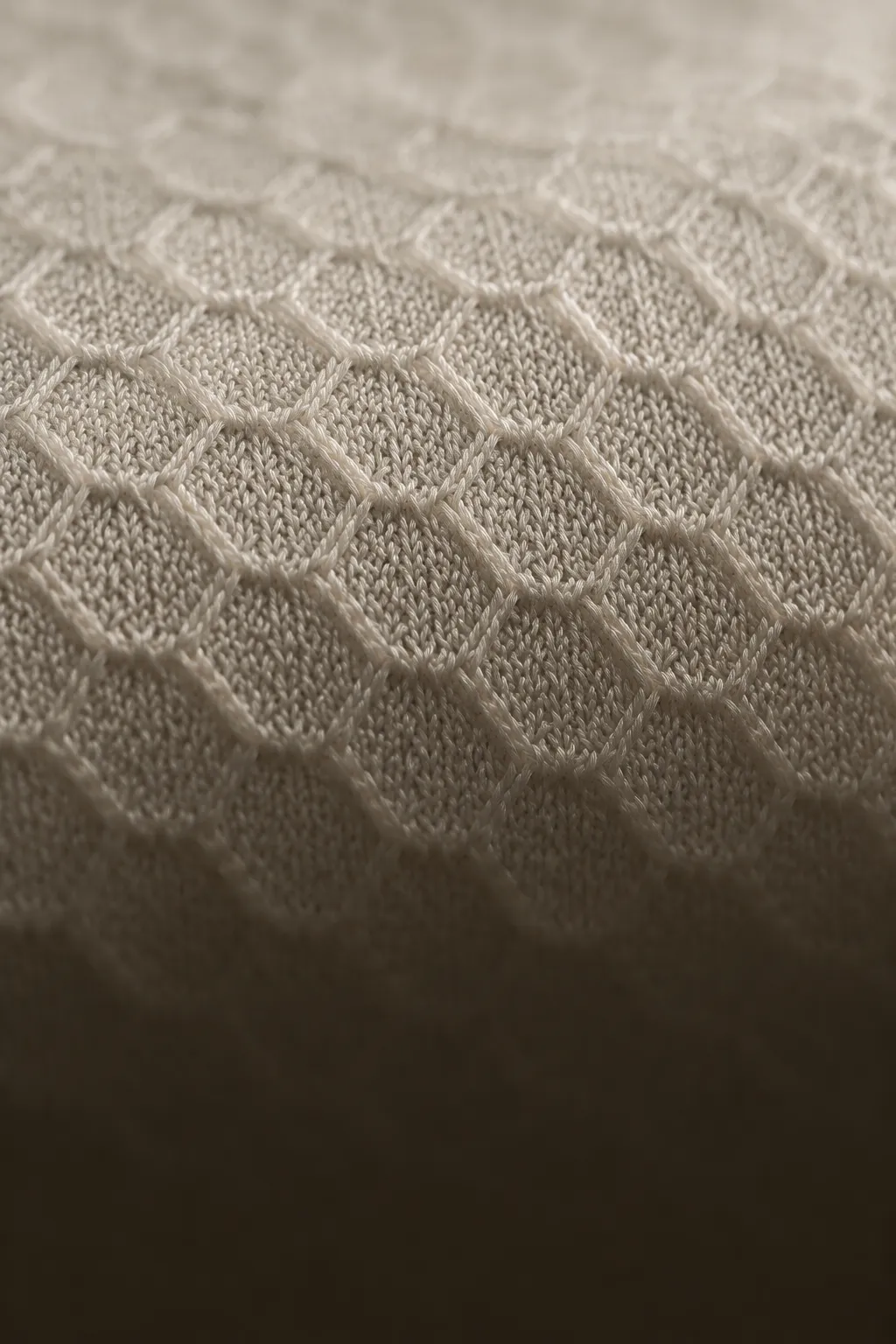
How a next-to-skin garment feels comes down to friction. Peptide modification lowers the coefficient of friction between fibre surface and skin, so the smoothness is a property of the fibre rather than a surface effect produced by softener or brushing. The difference shows after washing: a hand built on by finishing fades wash by wash, a modification at fibre level does not.
A Fibre That Holds Moisture
02 A Fibre That Holds Moisture
02

A Fibre That Holds Moisture

Ordinary synthetics take up almost no water; moisture can only sit in the spaces between fibres. The hydrophilic groups on the peptides let the fibre itself hold water molecules, giving a higher moisture regain than unmodified nylon. For next-to-skin wear this means the fabric does not turn dry and tight in low humidity, and builds up less static — the crackle when a garment comes off in winter comes from charge on dry fibres.

Drag or use arrow keys to explore

Performance may vary by fabric and construction. Confirm values against approved test documentation.

We'll be glad to collaborate with you.

Contact Us

Location

8F., No. 896, Jingguo Rd., Luzhu Dist., Taoyuan City 338018, Taiwan (R.O.C.)

Social

LinkedIn Instagram YouTube Website